2026/5/13

Fan Coil Unit: Composition, Principle, and Operation

Fan Coil Unit: Composition, Principles, and Operation

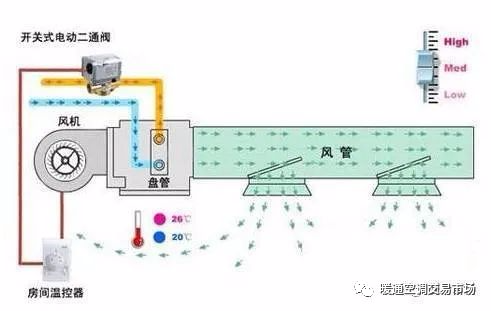
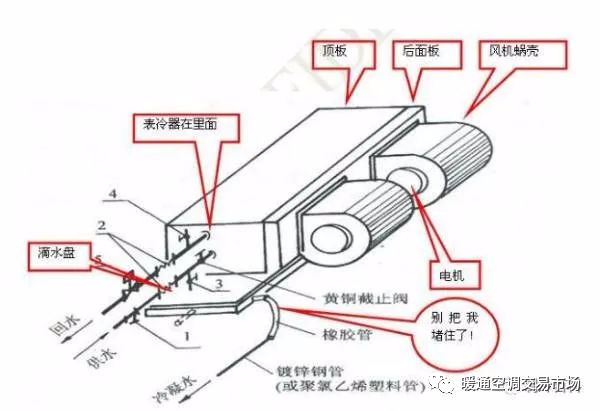
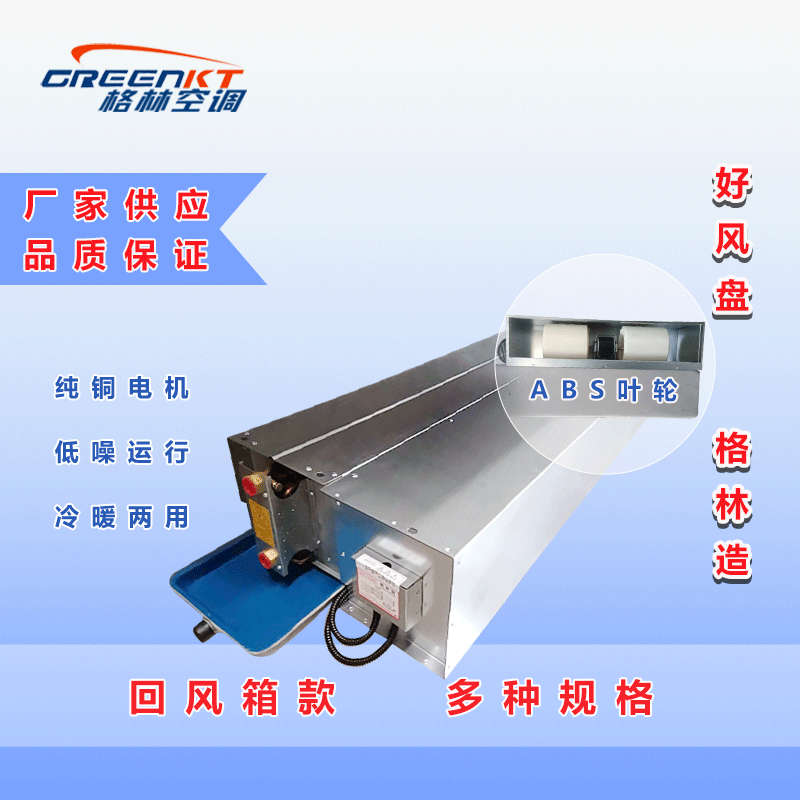
Fan coil units consist mainly of a fan, a heat exchange coil, and a casing. Based on external static pressure, they are classified as standard or high-static-pressure types. Based on the number of coil rows, they come in two-row or three-row configurations. The heat exchange coils typically use copper tubes with aluminum fins; the copper tube outer diameter ranges from 10 to 16 mm, fin thickness is approximately 0.15 to 0.2 mm, and fin spacing is 2.0 to 3.0 mm. Fans are generally dual-inlet forward-curved centrifugal types, and motors are capacitor-start single-phase 4-pole motors with three-speed settings. The casing and condensate pan are insulated.

Fan coil units continuously circulate indoor air through their coils to cool or heat it, maintaining the desired room temperature and relative humidity. The chilled or hot water used in the coils is supplied by centralized cooling and heating sources. Simultaneously, fresh air processed centrally in the fresh air handling unit is delivered to each conditioned space via dedicated ducts to meet hygiene requirements.

Compared to central systems, fan coil units eliminate large air ducts, requiring only water pipes and smaller fresh air ducts. They offer easy layout and installation, minimal space consumption, and superior individual control. Widely used in comfort HVAC applications where temperature and humidity precision requirements are moderate, featuring numerous small rooms that require independent control.

The working principle of fan coil units is simpler than that of central air conditioning. Think of a fan coil unit as an electric fan that blows air at your desired temperature.

I. Structure of Fan Coil Units

Fan: Driven by a single-phase, multi-speed, low-noise induction motor, the fan's speed is adjusted via input voltage to provide three airflow settings—high, medium, and low—controlled by an electrical switch. This regulates the cooling or heating capacity of the fan coil unit. As the primary air mover, the fan enhances convective heat transfer on the air side (outside the coil surface). Together with the motor, it also constitutes the main source of noise in the unit.

Coil: An air-to-water heat exchanger made of finned tubes. Chilled (or hot) water flows inside the tubes. Since the water temperature is below the air dew point, condensation forms on the outer surface, resulting in wet-surface heat transfer that involves both heat and mass exchange, thereby enhancing performance. The coil handles most or all of the room's cooling load. Tube rows typically range from 3 to 4.

Condensate Pan: Positioned beneath the coil with a drain pipe, it collects condensation from the coil and discharges it outdoors via the drain pipe.

Air Filter: Located beneath the coil with a drain pipe to collect condensate and discharge it outdoors.

II. Working Principle and Cooling Operation of Fan Coil Units

Fan coil units consist of water and air circuits. The water circuit delivers chilled or hot water from a central HVAC source (e.g., chiller) to the coils, where it circulates via pumps. In the air circuit, room air is drawn through return grilles by the fan, passes across the coils to exchange heat with the chilled or hot water, resulting in cooling and dehumidification before being supplied back into the room through supply grilles. This continuous cycle maintains indoor temperature and humidity levels.

The fan coil unit with fresh air system consists of two parts: the central air conditioning fan coil unit and the fresh air system. The fan coil unit serves as the terminal equipment for central air conditioning, while the fresh air system handles fresh air loads to ensure indoor air quality. This water-based HVAC configuration is a key form in chilled water systems and is widely adopted in private buildings.

Image and text sourced from the internet. All rights reserved by the original owner. Please contact us to request removal.

Contact Us

View more news

Return to News Center
Su ICP Prep 11090884 No. -3